
Adventures in Substackistan
Musings on community, online and off
[This is my “Substack origin story” — which is to say, an explication of how I got to Substackistan1 and what I imagine myself to be up to here. It is a meditative exploration of the ties that bind and fray. Originally, it was “Mulan’s Adventures […]” and staggeringly long, containing narrative details I’ve decided I’m not actually comfortable sharing. Those have now been redacted, with the hope that what remains (~85%; still quite long) is nevertheless legible and worth your while. Good-faith comments welcome. (Use a good-faith interpretation of “good faith”.)]
Greetings
Hi! My name is Felice (aka Mulan, by profile pic); you probably know me as a friendly neighborhood shitposter.
I came here, after many years reading, in order to comment on one specific piece in one publication out of the handful I’d been perusing, on a topic of some personal importance. Soon enough, I’d made myself comfortable in various comments sections and under some individuals’ Notes because they (which is to say, some of you) were so hospitable — to me, to the ideas I lazily spitball, to my whimsical rants about any number of Discourse-y issues that just so happened to land on the right side of amusing.
Before long, I’d banged out multiple paragraphs on one narrow matter that had been bothering me for a while, and thus was born my first real post2. It was in much the same vein as my comments here and there, but with my brain changed out of pajamas: tidier, more substantial — something more akin to actual rhetoric rather than merely mouthing off to some sympathetic ear into the ether. And this will be similar: I was moved to respond to this piece on Substacking by John Encaustum — someone I consider one of the most inventive and ambitious thinkers on this platform — to provide a counterpoint to his raison d’être for being here while simultaneously clarifying my own.
Friends
While I’m reticent with my biographical details, most probably already know the little I’m willing to share, which is that I’m a Millennial second-generation (East-) Asian American woman. The vicissitudes of life have left me detached from most pockets of Asian American community in recent years, and while I had felt more or less fine with that — I’ve long tended to feel Asian3 and American more than “Asian American”, and I’ve been around no shortage of Asians and Americans this entire time — the Atlanta spa shootings had me feeling distinctly untethered from…that to which I should supposedly have felt tethered, and searching for answers. My first recourse in the immediate aftermath, internet forums, sent me reeling, replete as they were with bone-chilling resentment against women like myself — when I was seeking some measure of solace instead.
Anyway, to fast-forward past potential digressions on race and identity and internecine gender relations, I found myself in a Substack comments section discussing such issues, […].
[Wherein we are introduced to someone called Y.]
[…And misadventure immediately ensues, involving a “good friend” of Y’s.]
[…] I had planned to leave Substack immediately after — […]. But by then, I had already begun to enjoy many interactions on here, and — despite feeling deeply spooked — was loath to give up the opportunity for conversations I could not easily have elsewhere: most intellectually stimulating, though unpretentiously and often effervescently so, and some riotously fun. Y’all are wonderful, and I appreciate you.
But wherefore the shitposting — as I blithely label my activity here? “I think we share many values yet have wildly different dispositions,” I mentioned to John: while he brings an extreme deliberateness to his writings, studiously avoiding shitposting and crafting meticulously reasoned-through essays, I am by comparison a sanguine agent of chaos, stylistically fastidious yet spontaneous and lackadaisical in the nature of my remarks.
One major throughline of John’s essays is a lifelong determination to find an intellectual community that he can call home. Among a generation where all feel obliged to perform ironic aloofness, he brings a wholly unabashed earnestness; in a world where it has become fashionable to profess a state of “political homelessness”, he has been doggedly trying to find kindred spirits and a place of ideological belonging — or, absent the existence of one, to build it himself. I find it admirable, inspirational…and utterly unrelatable.
Much has been written about the Asian American experience. I find most of it at turns mawkish, shrill, and querulous. I have no desire to contribute my voice to this collective body of work4, but I will not repudiate what is arguably the central thesis that can be distilled from it all: we build our communities in Tetris-like ways, fitting them among existing ones under shifting real-time constraints; and we are compelled to shoehorn ourselves into a limited set of prefab identities — those pre-approved for majority-culture consumption. I generally despise talk of “privilege”, freighted as it now is with progressive notions of Original Sin, but the implication is inescapable here: the determination to find a community where one truly belongs is a privilege of those who reasonably have hope of doing so, those who haven’t internalized the limitations foisted on them by their Otherness.
I would be lying if I said my first reaction to John’s noble goal wasn’t a flare of atavistic rage. It’s not fair. What absolute entitlement, to think that one deserves a community where they truly feel at home? What about just some uncramped niche where one doesn’t feel eternally like an alien, always at least slightly out of place and odd in one way or another, in the best-case scenario being an obedient adornment to the social fabric? Yet — as we were told back when oratory did not shrink from exhortation — to whom much is given, much is expected; what is a privilege in many cases may correspond to nothing less than a civic duty.
To navigate an Otherness delineated by those unlike and fundamentally uncurious about oneself entails finding camaraderie in clumps of those likewise Othered. John offers an exquisitely nuanced definition of solidarity as a property of human groupings that we have a moral imperative to understand and cultivate correctly. But the term marginalization is helpfully evocative: there are so many fewer degrees of freedom for the emergence of an ideal solidarity if those like oneself have been marginalized into disparate Othered clumps. Whereas the choosy beggar disdains what he can obtain, anything conceivably edible is manna from heaven to someone truly starved. An individual who shares culturally informed pain points can validate one’s experiences, and sometimes — in particular, when society has seemingly conspired to diminish not just those pain points and experiences but even the very humans they belong to — such a person can appear as the glow of a lone candle at a solitary nighttime vigil, with whom to share a certain fellowship of non-judgment and understanding.
Sanctuaries
It’s a pretty fun exercise to think through possible analogies for the communities and subcommunities found here on Substack. They can feel siloed, yet they are wholly porous; anyone can show up anywhere and speak their mind. My first day or so after creating an account, the algorithm showed me a Note from the eminently sane and thoughtful Daniel Muñoz, and it was thus that I discovered one of my haunts here, which some term “Philstack” — a confraternity of sorts for Substackers discussing philosophy. I vaguely conceive of Philstack as an ongoing interscholastic departmental happy hour, hosted by genial faculty, but as a picnic at a local park, where not only those from other departments but also the public at large are welcome.
What does it mean to build shared understanding in an environment as diverse as Philstack, never mind across an overlapping set of environments that can be similarly described? We know in our daily lives what we mean when we talk about the culture of an institution or its functional subdivisions (e.g., departments of various types). But the individuals present therein are not from all over and all walks of life; they have been selected by whatever powers that be with their potential fit in mind, with the expectation that they generally conform to the existing culture and affect it only modestly and beneficially. On the other hand, the diversity enabled by Substack’s open-doors nature begets pandemonium in any effort to hammer out a consensus for what exactly things mean, underlying assumptions from which to begin any fruitful discourse, never mind objectives for discourse in the first place….
I share John’s frustration that dialogue is difficult with, or amidst, a cacophony of unfiltered voices from an arbitrary crowd. It’s a fool’s errand to craft an effective message without some baseline certainty of who the audience even is. And how would one keep communities from schisming and subcommunities from careening off into strange oblivions, like glaciers being cleaved by climatic caprice from an ice shelf, without the warp of common experiences and weft of jointly held values to weave them together?
Online communities are more fractious and tenuous than real-life ones for many reasons.5 Chief among them, I think, is that individuals tend to bring only select aspects of themselves to them: those that are relevant to the specific interests of the group, and which conduce to the overall impression they hope to give. It’s advisable to leave the irrelevant parts of oneself offline, and possible to dispense with unflattering ones altogether. I’ve previously described this phenomenon as a low-dimensional projection of the self, but it’s rarely ever a completely faithful one, frequently exhibiting as it does convenient distortions. The performance of “authenticity” online became fetishized because most people’s natural orientation, when freed from the confines of meatspace, is a self-serving curation of the self.
Cast in these terms, online solidarity seems like a hopeless project. To dictate shared meaning at an optionally masked ball to which everyone and their mother and their mother’s pet parakeet is invited makes no sense. It would be madness not to expect the formation of fiefdoms grand and petty, many domiciled within their own semantic bubbles, with plenty of discord to go around.
And yet, I wonder if our real-life bonds have not in foundational ways decayed into similar insubstantiality, mutual understandings that should be unquestionably solid instead turning out to have been jerrybuilt because we withdrew into progressively smaller “safe spaces” of like-minded individuals. Not out of outright fear, per se, but out of being worn down in the face of hostility — general or acute, real or imagined. Safe spaces become comfort zones become home.
[Wherein I convey to Y how upset I am.]
[…To seemingly no effect.]
[Y finally responds, leaving me dumbfounded.]
[An explanation of why I was so taken aback.]
[Wherein I try my best to put myself in Y’s shoes.]
To me, anonymity on Substack is a cocoon of safety: I can freely express opinions it would be imprudent to even hint at in front of those who know me professionally; and I don’t have to physically fear anyone at all, as everyone I interact with exists behind a screen. It’s more than worth ceding what credibility I would have by being non-anonymous. And in fact, coming here with absolutely no stated bona fides, and earning the esteem of those I respect with nothing but what I say, is immensely gratifying.
Broad influence, though, is not handily achieved that way. It’s fine to forgo what authority one would derive from non-anonymity if one does not wish to do much more than flit across the landscape, partaking of conversation like a butterfly does nectar. But it can be a hefty price to pay if one aims to substantively influence communities and discourse. It just so happens that my goals are modest to the point of near-nonexistence. I am here to enjoy myself and leave discussions no worse than I found them; anything else I strive for would, I believe, be nothing more than sound and fury signifying nothing.
Reasons
Why my nihilism? It’s the same answer, really, to why my style is so punctilious, despite a decided casualness in traipsing through discussions I fancy. I don’t enjoy invoking identity, but that is at the crux of it. None of this is said in a bid for pathos; it is merely expository housekeeping. This is just how things are, and I am not young enough to bristle at it all. Any frustration there once was now barely even smolders.
I am who I am; I don’t get to make the same difference as others with the same effort. I don’t get second chances the way that others do. Hairsplitting precision is second nature to me, and I think one reason why is that I’ve never felt that I had the benefit of the doubt compared to others: I would be misunderstood where possible, even by an audience I myself could understand, so it was better to develop the ability to preempt misunderstanding, whether willful or incidental. I’ve never really felt that I would get the opportunity to explain myself, so it was better to avoid ever having to.
I don’t get to be heard in person, the way others do. It is often the advocacy of some of these others that most amplifies my voice — yes, in many cases, white men making sure that an Asian woman is heard, because they believe that what she has to say is worth hearing. Online and anonymous, of course, I advocate for myself and my ideas. Sometimes, others will find anonymous-me and her ideas worth advocating for, too. (I don’t take that for granted.) But I’ve had a lifetime to learn that my voice doesn’t project the same. So while that may be rendered irrelevant online, there is a certain devil-may-care resignation I bring to conversations: What can I hope to accomplish, beyond having fun? Is this learned helplessness? Possibly. Is it selfishness? Only if I’m presumptuous enough to think I have something uniquely valuable to contribute. But even then, I’m not sure — because whom do I owe, exactly; and what and why?
One of my more vibes-based takes, evoking the kind of gender essentialism that would get me in trouble professionally, is that boys build things; girls heal things. This is not a statement about aptitude, or intellectual inclination, but about the habits of the heart. I myself have always worked with predominantly men, and have been described as “male-brained” by those much more partial to such reductiveness. But my sense — and it is just an inkling, rather than an assertion I expect to ever be Popperianly vindicated — is that men and women gravitate towards different social tasks.6
Like John, Y also aspires to a certain manner of community-building. Faced with rot and malaise in the communities that matter to them, they each — men who are fantastically unalike along multiple axes — have invested no small amount of effort into their visions of better ones. Whereas I…it’s not that I feel that the problems are less severe, and so the solution the “lesser” one of reform over revolution. Rather, I lack the temperament to believe that any audacious vision I could have would be the right one. It’s not a hard-edged cynicism, but a simple-hearted skepticism. I believe in trying to heal what we have, because I don’t know what we would build instead.
Healing doesn’t mean just healing systems and institutions; it means healing the people within them, too. Pathologies of the body and brain are ministered to by credentialed physicians, but we can all heal kindred human souls just a little. To do so, though, we have to see them and hear them, and care. If this sounds trite, consider all those using AI as a stand-in therapist or for outright companionship. Consider how “emotional labor” came to be seen as a loathsome chore to keep score over, and not as a vital and non-transactional aspect of many relationships. Consider the all-consuming online communities people fall into — rightly labeled cults often enough — and too often with no one to fish them out of these vortices of belonging.
People sometimes strive to make for themselves cages more forbidding than those that others rather dispassionately inhabit because they have no choice. “Man, uncage thyself!” is hardly compassionate; to command someone to free themselves from a prison of their own construction is not unlike trying to flay them out of their reflexive self-flagellation. How did they end up there in the first place?
To listen to someone doesn’t mean to uncritically believe everything they say, in the same way that “listen to your body” doesn’t meant to take all of its signals at face value — never mind to obey all its whims. But it’s impossible to know how people’s own stories are hurting them if you don’t bother to understand those stories in the first place. People tell their rawest stories — with what they believe to be their utmost honesty — in their safe spaces. You can go there to listen; or if you can’t gain access, you can try to erect a makeshift safe space for them, upon the common ground you share. That’s not to say they’ll want to go there, though. Maybe their only safe space is the cage they can call their own.
Fragments
Existing across distinct communities requires some finesse; the capacity to pivot accordingly, to not just code-switch but also character-switch, is a trait of a well-rounded person. A pluralistic society rewards the chameleon. Yet if one has only ever known existence amidst such fragmentation, how can the self — if it is even recognized, and not hopelessly camouflaged in a thicket of culturally contingent ephemera — not be irretrievably fragmented as well?
Intersectionality gets a bad rap because it is so frequently shanghaied for oppression-Olympics shenanigans. But it can also be construed as a way to make sense of the multiple pieces that comprise us: “Here, this is what I am, and this; and this, too. All of these pieces put together are more than their sum; they are me.” It’s like layering shards of translucent glass one atop another, in the faith that the light refracted through their composition must be qualitatively different from that which comes through each individual shard. A desire for such photonic arbitrage, an identitarian alchemy whereby new ways of being — or at least of seeing and understanding oneself — emerge from that which has been broken, is ineffably human.
But this compulsion to compose and compose and compose categories that partially characterize us — it just leads to more societal fracturing, and therefore recursive atomization. Because ultimately, no one else shares that pinpoint intersection of the innumerable fine-grained identities that defines each of us. And if only all those who amass identities for personal sense-making — who horde the borosilicate-like shards of themselves so that they might stack them high and examine their own biopsied souls by peering through the rickety tower of them (as if they were the lenses of a MacGyvered ontological microscope) — would instead unburden themselves of that precious yet wretched collection. To not hold those fragments of essentialized self so close to their hearts, but set them down so that we might piece them together, fitting them carefully to one another and filling the crevices in between with…I don’t know.
Love, some Christians would say. But I don’t know what that means in this context, exactly; and I’m not sure many of them do, either. Maybe just some sort of spiritual polymer — near-interminably linked monomers of giving-a-fuck-ness — that bonds fast and, after it cures, is resilient. To the shearing of sporadic blunt-force provocation. To the kinds of tiny cuts that can descend like locusts by the thousands. To rough-and-tumble wear and tear, because life isn’t about being handled like a Fabergé egg. And as with individual humans, so, too, with their communities, we might hope.
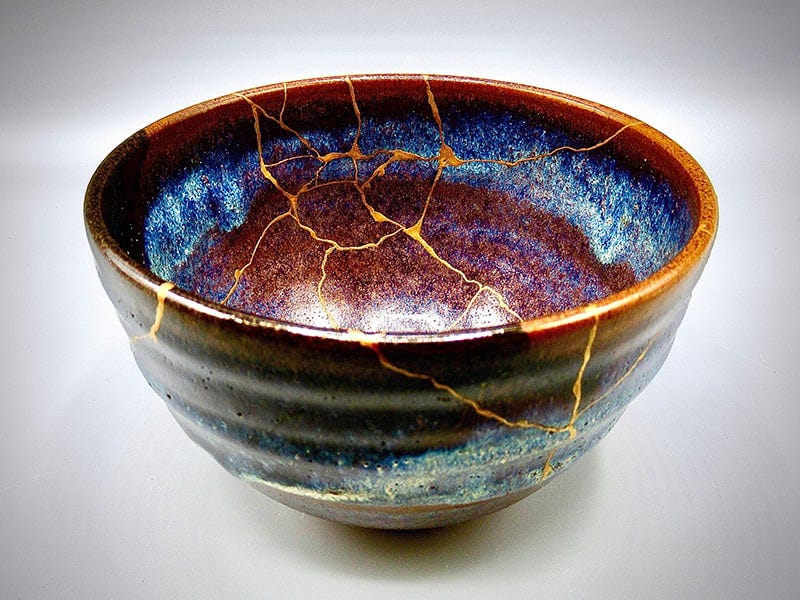
The Japanese art of kintsugi is a stunning method of repairing cracks in pottery by filling them with precious metal-pigmented lacquer, thereby transforming imperfections and weakness into beauty and strength. Once those cracks have been fully split open, though, probably no means of un-splintering the pieces admits a technique of such artistry. But healing isn’t about art (even if art can heal). Healing is about presence. Not a forceful one, necessarily, but a steadfast one. An unflinching one. Vulnerability is often fetishized alongside authenticity, but real vulnerability — not the performative kind meant to be applauded — is often ugly. If we retreat into our safe spaces when people bare their brokenness to us, equating it with an irredeemable ugliness, how can we help them heal?
Not in parallel, upon islands of our own, then, but in series, across an irregular network — that is how the fragments of ourselves, and our communities, should be arrayed, I submit. And when they are in hapless disarray, healing is probably the painstaking process of organizing them thus. It’s not a clean-cut matter of asking whether individual elements “spark joy”, and discarding those that do not; it’s a matter of figuring out how to meaningfully incorporate even the jagged and weird and unsightly ones into the motley circuitry of ourselves and our communities. Put this way, it is perhaps not too different from building, after all, as there are multifarious design choices in how separate entities are joined together. Are individuals built anew when they heal?
I don’t know. Maybe it’s just that my imagination demurs at tasks of moral grandeur; an architecture of oughts is not for the epistemically timid. But sometimes — so much of the time — that which can be healed, even if just a little, is right there. Maybe building vs. healing is ultimately about global vs. local. Do we endeavor to make a difference “out there”, in the indeterminate vastness beyond us, or in the surroundings we have chosen or that happened to choose us? Rather than embarking on missions to engineer better new worlds, I will be right here, wherever it is that I find myself: within a sanctuary, part of a sanctuary — and existing as a sanctuary, to the extent that I can. Unlike a safe space, which serves as a bomb shelter for the soul, a sanctuary is a spiritually ventilated refuge where voices are given the air to be resonant. I think it’s possible to maintain within ourselves a small proto-chapel for others, and open the windows just a salutary crack. And I shall try.
Ever tried. Ever failed. No matter. Try again. Fail again. Fail better.
Credit to Kryptogal (Kate, if you like) for the coinage, which I find endlessly entertaining.
An extemporaneous excursion in verse one idle evening notwithstanding.
Or more precisely, identifying with my specific ethnicity and my parents’ homeland. Jay Caspian Kang has written about the contrived nature of a pan-Asian identity, which is after all a postwar social project: “‘Asian-American’ is a mostly meaningless term. Nobody grows up speaking Asian-American, nobody sits down to Asian-American food with their Asian-American parents and nobody goes on pilgrimages back to their motherland of Asian-America.”
Though he is not from the same generation nor of the same gender, Wesley Yang has said most of what I would say on the subject. And perhaps what there is for those of like minds to say has by now been exhausted, as he has moved on to talking about trans issues and the like, and there isn’t any particular Asian American issue I wish he would write about instead. Can’t say I would mind having his voice back in the mix, though.
Grateful for discussions across multiple comments and Notes with Not-Toby and Daniel M on internet-mediated atomization of communities and the implications for our social fabric.
“That’s just, like, your opinion, woman.” Why, yes it is; and this is my essay! And I decline to elaborate for now.
Well, this is wildly complimentary to me! Thanks, and I will be somewhat embarrassed I'm off-schedule right now, struggling to fit my Substack writing into everything else. I'm trying to get back on it, and perhaps I will next week. (This week I'll only have one letter out, planned for Friday.)
I appreciate these thoughts a lot, and I'm happy to complement a lot of other types of style and attitude here (including a lot of the shitposting even if I'm not doing it). I have a less always-rosy view of solidarity in general – though I think it's important, I count most "tribalism" as solidarity and I count cancellation as a phenomenon of solidarities – so I see online solidarity as very common, not utopian, and not always for the best! Getting ones I'll belong in online... yes, that's going to be hard.
A couple of your metaphors really stood out to me. One is the kintsugi: it strikes me that what I'd ideally like my Hedge to grow into is one of those joining veins of gold. People do feel like society shattered and needs some putting back together, and I've been leaning away from that metaphor but maybe kintsugi would be a good way to lean into it instead. A second is the glacier: you wouldn't know it, but I've run some reading groups based around an "ideological glaciers melting" theme! I was asked for a name for the club and just happened to be reading Pielou's After the Ice Age at the time, but it stuck.
Overall, I like your intentions regarding sanctuaries and healing and I hope I can help those. This was warm, bright, and present! I'll look forward to more paragraphs whenever you're moved to write them.
So reading this I was really brought back to Arendt's Sonning Prize acceptance speech, which kinda hilarious: https://miscellaneousmaterial.blogspot.com/2011/08/hannah-arendt-sonning-prize-acceptance.html
"Ever since I received the rather startling news of your decision to choose me as the recipient of the Sonning Prize in recognition of my contribution to European civilization, I have been trying to figure out what I could possibly say in response..."
She sees all of "society" the way you paint the online here. "[W]e are accepted as individuals in our own right and yet by no means as human beings as such." Rather, we are known by our role, an aspect of ourselves relevant to the context, a sort of mask (a persona, per-sonare, which we "sound through,"). To the question of solidarity and coherent self-identity given this, she says: "It is through this role, sounding through it, as it were, that something else manifests itself, something entirely idiosyncratic and undefinable and still unmistakably identifiable, so that we are not confused by a sudden change of roles, when for instance ... a hostess, whom socially we know as a physician, serves drinks instead of taking care of her patients." Our roles are only partial, and to a large degree they are enforced upon us, but they are not permanent or total. Because we all experience wearing these masks, we know that we only get a mediated understanding of others wearing them, which enables us to work cleverly around them.
Reading your piece and thinking about this led me to think that maybe the problem with the internet isn't that we are so curated, but that we think we shouldn't be. We all know that the physician who does not serve drinks at the hospital *could* do so at home. But the idea of the internet as allowing a sort of unmediated authenticity - weird to asssume! but unquestionably the assumption underpinning the popularity of e.g. b/vlogs - leads us to forget that we are only seeing a mask. Or maybe it's just the 24/7 nature of it, the parasociality. Or, maybe it's how we ourselves are uncertain of how much we should or even *do* reveal of ourselves online, and sense that others are as well.
Rooted in Christian thinking I would take a stab at the "glue" and say that yes, grace is ultimately what holds this together, encourages a recognition of intersectionality and a listening prolonged enough to piece together multiple masks.
(The reason this is hilarious is because it's all a long-winded way of saying she can only accept an award like this as a "recognition which, in no matter what form, can only recognize us as such-and-such, that is, as something which we fundamentally are not.")